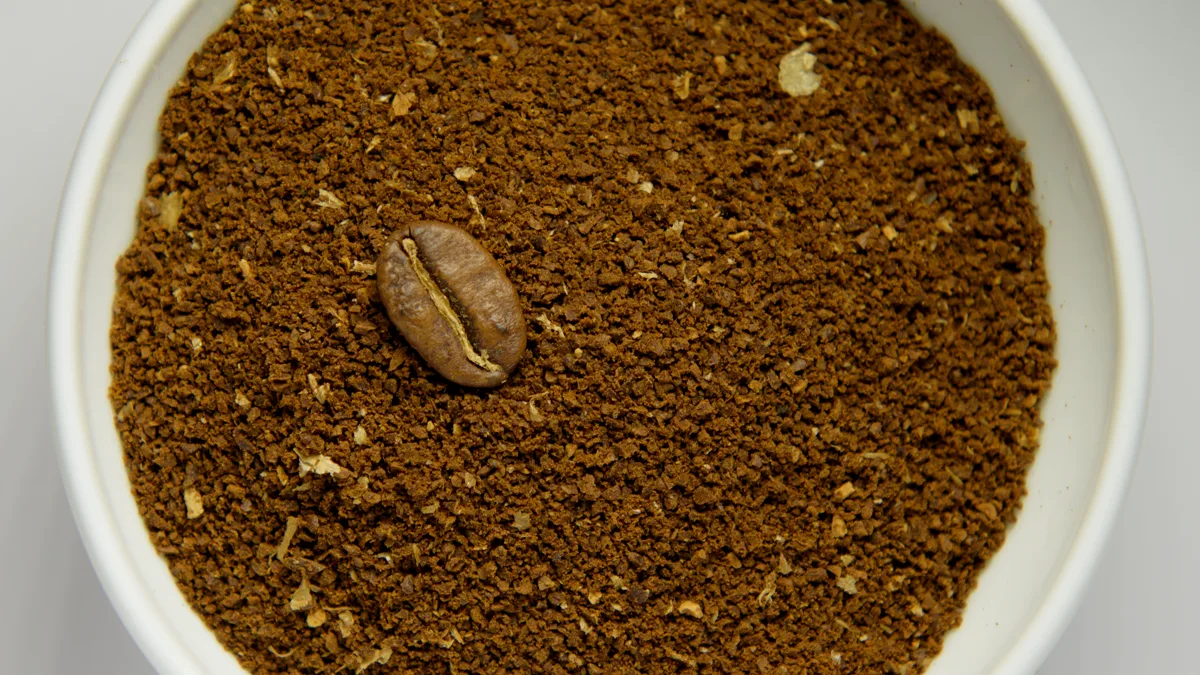
Grind guide summary The optimal coffee grind size french press brewing demands is coarse, resembling rough kosher sea salt or breadcrumbs. Coarse particles provide balanced extraction across a four-minute immersion while preventing microscopic fines from slipping through the wire mesh filter and causing muddy silt.
The French press is universally celebrated as the most forgiving and approachable manual coffee brewer in existence. You add coffee, pour hot water, wait several minutes, and plunge. Yet despite this mechanical simplicity, thousands of home brewers struggle with press pot coffee that tastes unpleasantly bitter, chalky, or thick with muddy sludge.
In nearly every instance of press pot disappointment, the issue is not brewing time, bean freshness, or water ratio; it is an improper, inconsistent grind size. Grind size dictates both the speed of chemical extraction and the physical efficacy of the metal mesh filter screen.
Grinding coffee too fine produces an over-extracted, astringent cup clogged with suspended micro-particles that escape into your mug. Conversely, grinding excessively coarse yields a thin, sour, watery beverage that lacks the rich chocolate mouthfeel for which the French press is legendary.
Mastering grind consistency transforms the press pot into a precision brewing instrument capable of producing sweet, heavy-bodied cups with remarkable clarity.
- Kosher Salt Visual Benchmark: Target coarse, distinctly jagged particles resembling rough kosher sea salt or panko breadcrumbs.
- Mesh Filtration Mechanics: Metal screens possess porous apertures (about one hundred to one hundred fifty microns); fine particles pass through easily.
- Immersion Extraction Kinetics: Four to five minutes of full immersion requires large particle diameters to prevent bitter over-extraction.
- Burr Grinder Mandate: Blade grinders pulverize beans unevenly, generating massive clouds of fine dust that ruin French press clarity.
- The James Hoffmann Skimming Tweak: Scooping surface foam and floating grounds before plunging eliminates sediment without changing grind size.
Why Coffee Grind Size French Press Brewing Demands Is the Decisive Factor?
Dialing in the correct coffee grind size french press brewing requires understanding immersion fluid dynamics. In drip or pour over brewing, water percolates through grounds in seconds, requiring medium particles to slow down water flow.
In a French press, coffee grounds remain completely submerged in hot water for four to five continuous minutes. This extended contact time means that chemical extraction occurs relentlessly across the entire surface area of every particle.
If you use a medium or fine grind intended for drip machines or espresso, the enormous total surface area causes rapid over-extraction. Bitter polyphenols, harsh plant chlorogenic acids, and astringent compounds flood the liquid within two minutes.
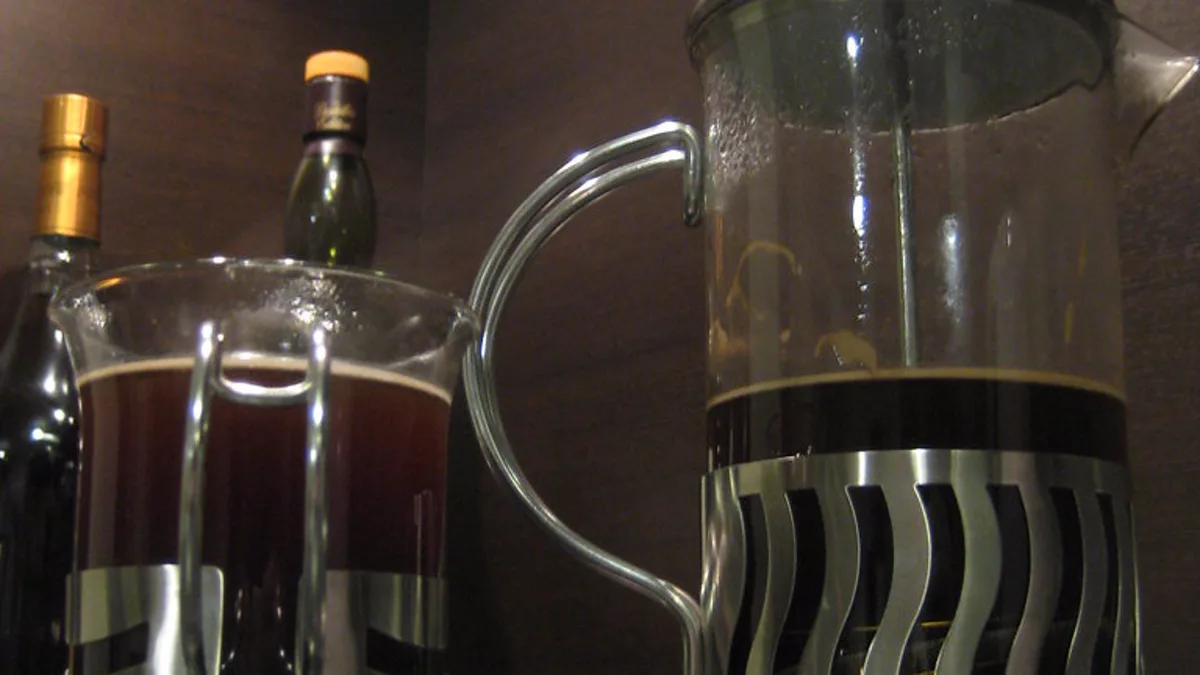
Beyond that, the plunger mechanism relies on a circular stainless steel wire mesh screen. This mesh acts as a physical sieve with apertures around one hundred to one hundred fifty microns. Fine grounds slip right through the mesh into your cup, creating unpleasant sludge. Exploring these proportions pairs smoothly with our French press coffee ratio guide, core French press vs pour over comparison, and broader coffee brewing archive.
How Does French Press Coarse Grind Fit Along the Coffee Grind Spectrum?
French press coarse grind occupies the upper threshold of the coffee particle spectrum, averaging around one thousand microns in diameter to match immersion extraction kinetics. Placing coarse grind in context prevents confusion with drip settings.
Understanding where French press grind fits within the broader specialty coffee spectrum helps you calibrate your grinder burrs accurately:
| Grind Classification | Particle Visual Texture | Tactile Sensation | Primary Brew Method | Average Micron Size |
|---|---|---|---|---|
| Extra Coarse | Coarse rock salt, crushed peppercorns | Rough, distinct individual chunks | Cold Brew immersion | 1,000 to 1,200 μm |
| Coarse (French Press) | Kosher sea salt, panko breadcrumbs | Distinct gritty flakes | French Press / Cupping | 800 to 1,000 μm |
| Medium-Coarse | Rough beach sand | Granular with small flakes | Chemex / Clever Dripper | 700 to 800 μm |
| Medium | Standard table salt | Uniform sand-like texture | Flat-bottom Drip / Aeropress | 500 to 700 μm |
| Medium-Fine | Fine dry beach sand | Smooth gritty powder | Conical Pour Over (V60) | 400 to 500 μm |
| Fine | Finely ground flour or powdered sugar | Silky soft with slight grit | Espresso / Moka Pot | 200 to 300 μm |
Source: Specialty Coffee Association (SCA) Particle Size Standards (reviewed October 2026).
Why Do Blade Grinders Produce Muddy French Press Coffee?
Blade grinders produce muddy French press coffee because spinning metal propellers smash coffee beans violently rather than cutting them evenly, generating vast clouds of microscopic dust called fines. These micro-particles slip past wire mesh filters easily.
Propeller blade grinders function like kitchen blenders: high-speed spinning blades smash coffee beans violently. The result is a chaotic particle distribution containing large boulder-sized chunks mixed with fine, flour-like dust known as fines.
In a French press, this particle disparity is fatal to cup quality. The microscopic fines over-extract in sixty seconds, leaching bitter astringency into the brew and floating directly through the metal mesh filter into your mug.
Meanwhile, the giant boulder particles remain largely under-extracted in the center, producing sour, thin notes. The resulting cup tastes unpleasantly bitter and sour simultaneously, coated in a thick layer of gritty mud.
Investing in a conical or flat burr grinder is non-negotiable for French press brewing. Burr grinders crush beans between two precision-machined cutting rings, producing uniform particle sizes with minimal fines.
What Are the Exact Burr Grinder Settings for Popular Home Models?
Burr grinder settings for French press typically sit near the upper thirty percent of the adjustment range, such as setting twenty-eight on a Baratza Encore or thirty clicks on a Comandante C40. Calibrating according to manufacturer micron output ensures clean cups.
Every grinder model features unique calibration scales. While individual manufacturing tolerances vary slightly, these baseline starting points will put you in the ideal coarse French press zone:
- Baratza Encore / Virtuoso+: Start at setting 28 to 30; adjust down to 26 if the brew tastes weak, or up to 32 if plunging feels stiff.
- Fellow Ode Gen 2: Target setting 8.0 to 9.0; the wide flat burrs produce fewer fines, allowing slightly finer settings than conical grinders.
- Comandante C40 MK4: Count 28 to 32 clicks from true zero for clean coarse immersion extraction.
- 1Zpresso JX-Pro / K-Ultra: Dial to 3.8 to 4.2 full rotations from zero, giving uniform 900-micron coarse flakes.
- Timemore Chestnut C2 / C3: Set to 22 to 24 clicks from closed position to preserve filter screen clarity.
How Does the Two-Spoon Skimming Technique Eliminate Sediment?
The two-spoon skimming technique eliminates sediment by breaking the floating coffee crust at minute four and using two large soup spoons to scoop off oily foam and suspended fines before plunging. Plunging only to the water surface leaves remaining silt settled undisturbed.
Championed by World Barista Champion James Hoffmann, the two-spoon skimming method has revolutionized home French press preparation. It completely eliminates muddy silt without requiring paper filters or specialized gear.
After pouring hot water over your coarse grounds, let the coffee steep untouched for four minutes. A thick crust of grounds and aromatic oils will form on the liquid surface.
At the four-minute mark, take a soup spoon and gently stir the surface crust. Most of the grounds will immediately sink to the bottom of the carafe. A creamy layer of white foam and floating chaff will remain on top.
Take two spoons and skim this foam and floating chaff off the surface, discarding it. Place the plunger lid on top, but do not plunge down through the liquid; press the filter down only one inch to submerge the mesh below the spout, and pour gently. Your cup will be remarkably clean and sweet.
Frequently Asked Questions
Can I use medium drip grind in a French press if I plunge gently?
Using medium drip grind causes over-extraction and bitter taste, and fine grounds will still slip through the metal mesh filter regardless of how gently you plunge.
Why is my French press plunger so hard to push down?
A hard plunger indicates your grind size is too fine. Fine particles clog the microscopic openings of the mesh screen, building dangerous hydraulic pressure inside the glass carafe.
Should I stir the coffee grounds right after pouring hot water?
A gentle stir right after pouring ensures all dry grounds are fully saturated. However, avoid violent stirring, which increases fines and speeds up bitter tannin extraction.
How long should French press coffee steep with coarse grind?
Four to five minutes is standard for coarse grind. If using the James Hoffmann skimming method, letting the coffee settle for five to eight minutes after skimming improves clarity further.
Can I put a paper filter inside my French press to remove silt?
Yes. Placing a circular paper filter (like an Aeropress filter) between the metal mesh and the plunger base traps all micro-fines, producing a paper-clean cup with French press body.
How we researched this: Brewing metrics follow established Specialty Coffee Association protocols and blind sensory testing on multiple roast profiles. An AI tool drafted the initial structure, and the writer verified every ratio and step.